E-Commerce or Standard Website: What Suits Your Business?
Your goals determine the choice:
- E-commerce website: Perfect if you want to sell products directly online. Features such as shopping cart, payment processing, and inventory management are integrated. Prices start from €4,200.
- Standard website: Ideal for businesses that want to provide information and present their brand. Suitable for service providers and consultants. Prices from €1,900.
Comparison of the two types:
AspectE-Commerce WebsiteStandard WebsiteMain purposeSell productsProvide informationFeaturesShoppingcart, payment systemContact forms, contentMaintenance effortHighModerateCostsFrom €4,200From €1,900
Important considerations:
- Target audience: Online shopping in Austria is growing – 62.4% already shop online.
- Industry: Retail benefits from e-commerce, while service providers often manage well with standard websites.
- Mobile optimisation: Essential for both types, as mobile usage has increased by 36%.
Conclusion: Choose the website that best supports your business goals. Welle West offers solutions for both types, tailored to the Austrian market.
Differences Between E-Commerce and Standard Websites
What Is an E-Commerce Website?
An e-commerce website enables you to sell products or services directly online. It offers features such as a shopping cart, payment processing, and inventory management. The focus is on processing transactions securely and efficiently. A user-friendly design helps minimise cart abandonment.
Imagine a fashion shop in Vienna selling its collection via an online platform – that is a typical e-commerce website.
What Is a Standard Website?
A standard website focuses on providing information and presenting a brand. It typically contains company details, an overview of services, and contact options. Unlike an e-commerce site, there are no direct sales features. The focus is on maintaining and updating content.
An example would be a consulting firm from Carinthia presenting its services and contact details on its website. This type of website is particularly well suited for service providers, consultants, or businesses looking to inform and engage their customers.
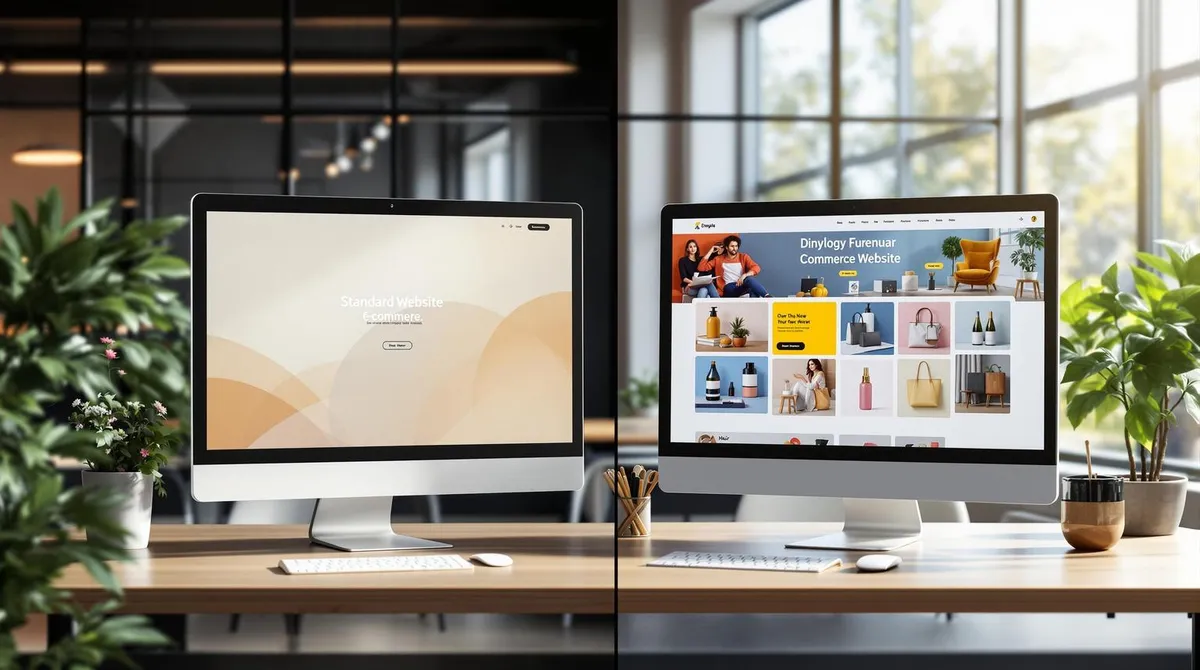
Here is a comparison of the two website types:
AspectE-Commerce WebsiteStandard WebsiteMain purposeSell products onlineProvide information and strengthen the brandCore featuresShoppingcart, payment processing, inventory managementContent management, contact forms, information pagesSecurity requirementsHighest protection for payment and customer dataBasic data protectionMaintenance effortRegular product and price updatesOccasional content updatesCostsFrom €4,200 at Welle WestFrom €1,900 at Welle West
E-commerce websites generate direct revenue through sales, while standard websites aim to strengthen the brand and build customer relationships.
Choosing the Right Website for Your Business
Defining Your Business Goals
The choice of the right website type depends heavily on your goals. Do you want to sell products directly? Then an e-commerce website is the best choice. Is your focus more on brand building or providing information? A standard website serves this purpose excellently. For example, a sports shop in Tyrol was able to expand its reach and acquire new customers across Austria by launching an online shop. However, understanding your target audience is just as important as your business goals.
Knowing Your Target Audience
Mobile device usage for online access in Austria has increased by 36%. This means a mobile-friendly website is a must today – regardless of the website type you choose. Imagine a consulting firm in Salzburg investing in a mobile-optimised standard website: it could not only reach its customers more effectively but also generate more enquiries. In addition to your target audience, your industry also plays a decisive role in choosing the right website.
Considering Your Industry
Your industry's requirements often dictate which website type is the best fit. Here is an overview:
Industry****Recommended Website TypeRetailE-commerce for direct online salesConsulting/ServicesStandard for professional information deliveryCrafts/TradesStandard with contact form for targeted enquiriesHospitalityStandard with reservation system for table bookings
Features of E-Commerce and Standard Websites
E-Commerce Website Features
E-commerce websites are specifically designed to sell products online. They offer features such as a dynamic product catalogue, a shopping cart system, and secure payment options. A seamless purchasing process is the focal point. Important features also include inventory management and automated shipping solutions that make operations more efficient. As more people shop on mobile devices, a user-friendly mobile version is a must. Integration of payment methods for smartphones is also crucial for reaching customers on the go. SEO measures are particularly focused on product pages and categories to increase visibility. With 62.4% of online shoppers in Austria, it is clear: mobile optimisation is essential.
Standard Website Features
Standard websites primarily serve to convey information and build a brand presence. They are excellent for businesses looking to present their services or products and generate customer contacts. Typical features include simple contact options, appointment booking systems, and feedback forms. Due to their manageable structure, they are more cost-effective to create and maintain. The SEO strategy here focuses on local search terms and industry-specific content to effectively reach the target audience.
To better understand the differences between both website types, the following table shows the key features in comparison:
FeatureE-Commerce WebsiteStandard WebsiteProduct catalogueExtensive with ordering functionalitySimple presentationPayment systemIntegratedNot requiredInventory managementAutomatedNot availableContact optionsMultiple optionsBasic contact optionsMobile optimisationFull with shop functionalityBasic adaptationMaintenance effortHighModerateSEO featuresFocus on products and categoriesFocus on local content
With a current share of 6% of total retail in Austria, online commerce still has significant room for growth. Which type of website you should choose depends on your specific business requirements and long-term goals.
Costs and Maintenance
Website Costs
The costs for a website depend heavily on its type and the desired features. At Welle West, standard websites start at €1,900, while e-commerce websites start at €4,200 due to their more extensive features. Extended websites are available from €2,700, and additional pages can be added for €100 per page. For e-commerce websites, 10 products are pre-integrated.
Maintenance Requirements
E-commerce websites require more maintenance than standard websites, as they have a more complex structure and higher security requirements. Here is a comparison of the key maintenance tasks:
Maintenance aspectE-Commerce WebsiteStandard WebsiteSecurity updatesWeeklyMonthlyContent updatesDaily/WeeklyMonthlyPerformance checksWeeklyQuarterly
Welle West Pricing Options
In addition to pure development costs, maintenance effort also plays a significant role in selecting the right website solution. Welle West offers individually tailored packages that cover various business requirements. The e-commerce packages include important features such as SEO optimisation, speed optimisation, and conversion optimisation, which can help increase visibility, reduce loading times, and generate more sales.
Given the average annual spending of €1,840 per online shopper in Austria, the investment in a well-developed e-commerce website can quickly pay off. Furthermore, all Welle West website packages are optimised for mobile devices to accommodate the growing number of smartphone users.
Whether you opt for a standard or e-commerce solution depends on your individual requirements. Welle West offers solutions that are both cost-effective and easy to maintain.
Related Video from YouTube
Conclusion
With prices starting at €1,900 for standard websites and €4,200 for e-commerce platforms, Welle West offers suitable options for various business requirements. However, it is not just about costs – your specific goals and needs are crucial for making the right choice. A mobile-friendly design is essential to reach the steadily growing number of smartphone users in Austria.
The decision depends on your business priorities. Standard websites are ideal for:
- Service companies, information portals, and company profiles with contact options.
E-commerce websites are particularly suitable for:
- Businesses looking to sell products online, pursue a flexible business model, or benefit from lower operating costs.